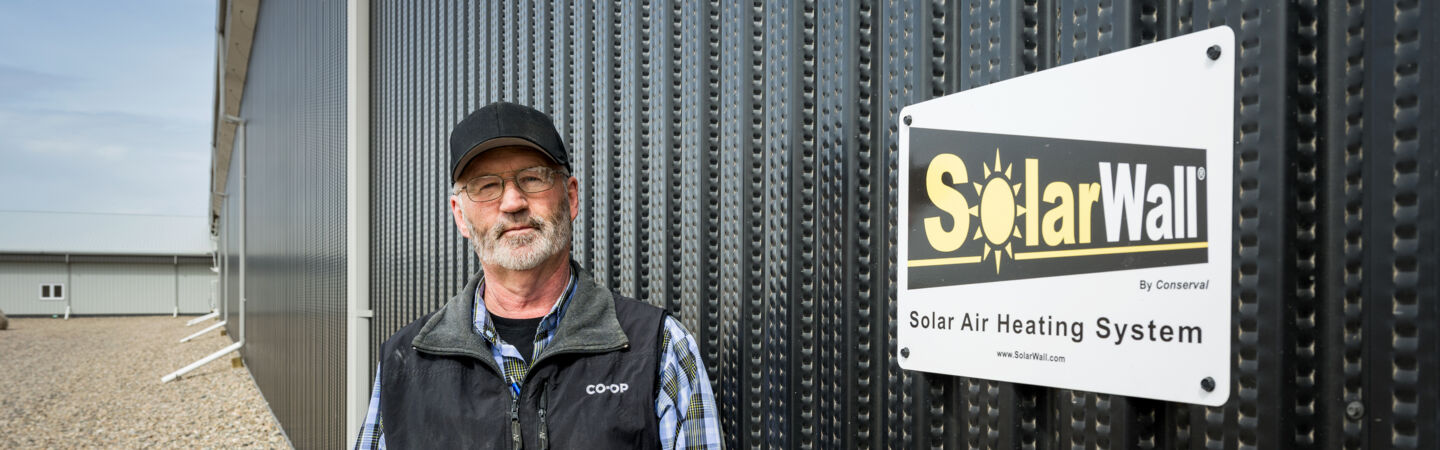
Huron Poultry: An egg farm with solar-heated walls
By Egg Farmers of CanadaThis profile is the second in the Innovative farmer series—a collection of on-farm profiles that highlight sustainability and innovation projects underway on Canadian egg farms.
Huron Poultry, part of the Huron Hutterite Colony near Brownlee, Saskatchewan, is finding smart, practical ways to farm more sustainably.
Ben Entz, who has managed Huron Poultry for over 30 years, led the integration of solar wall technology during the construction of a new barn in 2019.
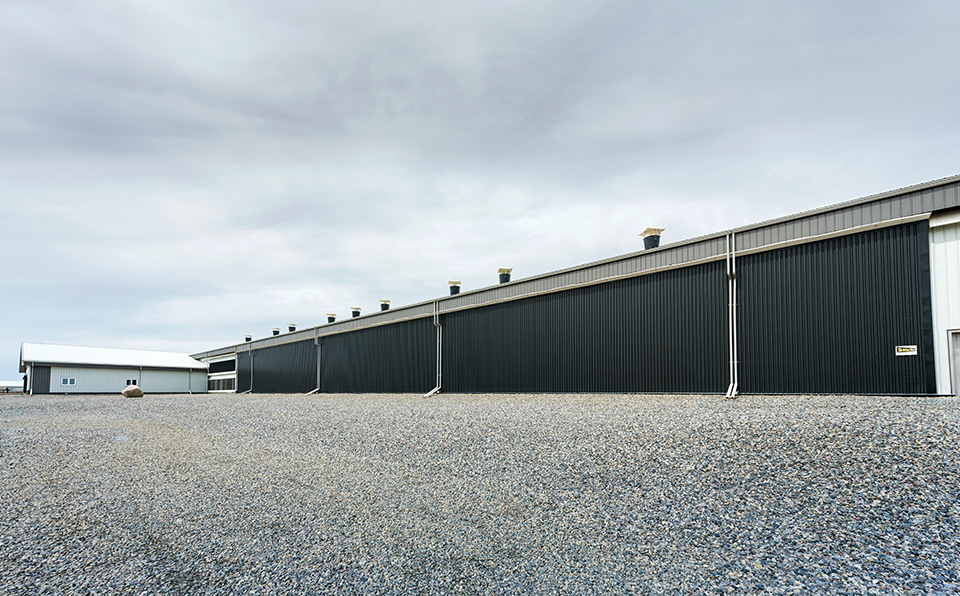
Facing the challenge of heating a large barn, Ben wanted a solution that would reduce energy costs without compromising hen comfort or egg production. Saskatchewan’s long, cold winters combined with high solar potential1 made air heating an ideal solution, particularly in a province that receives more than 2,300 hours of sunlight annually.2
“It’s about building something that works for the birds, the environment and the long-term,” says Ben.
How the solar wall system works
The core of the innovation is the SolarWall®, system, a simple, non-moving technology consisting of dark, perforated steel panels installed across a portion of the barn’s exterior wall.

When sunlight hits the dark panels, the incoming air is preheated. The warm air is then drawn into the attic and used for barn ventilation during winter, which significantly reduces the farm’s reliance on propane or natural gas as a heat source. The system is bypassed during the summer, and the heating, ventilation and air conditioning (HVAC) draws air directly from ambient air.
The impact of solar-assisted heating
The solar wall system has delivered multiple operational and environmental benefits for Huron Poultry:
- Energy savings: The system offsets approximately 22,000 m³ of gas annually. This is roughly the amount of natural gas it would take to heat about nine average Canadian homes.3
- Carbon footprint reduction: In one year, the farm estimated saving 126 tonnes of CO2. This is equivalent to the carbon sequestered by more than 2,000 tree seedlings grown for 10 years.4
- Benefits for animal care: The consistent, solar-heated airflow helps maintain a more stable barn climate by boosting airflow without losing heat.
- Operational benefits: The system is incredibly effective at warming up cold air. For example, on a frigid -20°C day, the solar wall can boost the incoming air temperature all the way to 2°C. Ben notes that, thanks to this free heat from the sun, the barn’s main heaters can stay off for about six hours on winter days.
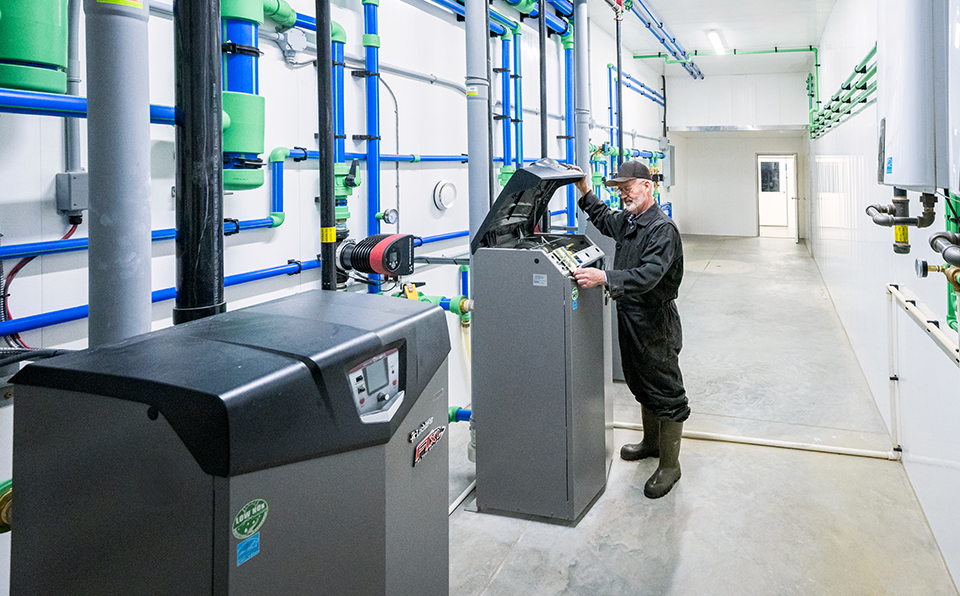
This solar wall technology at Huron Poultry is just one example of how Canadian farmers care for their flocks while also caring for the environment. Ben’s advice to other farmers is to understand your barn ventilation system before implementing this technology in a new build or by retrofitting existing barns. He is also exploring other renewable solutions, such as integrating a rapid composting system powered by renewable energy.
Learn more about this solar energy project at Huron Poultry by reading our fact sheet.
1 Natural Resources Canada. (2025, January 16). Photovoltaic potential and solar resource maps of Canada. https://natural-resources.canada.ca
2 Parker Hannifin Corporation. (2025). Innovative air filtration for agricultural facilities. https://www.parker.com
3 Statistics Canada. (2024). Table 25-10-0060-01 Household energy consumption, Canada and provinces [Data Table]. https://doi.org
4 United States Environmental Protection Agency. (2025, February 24). Greenhouse gas equivalencies calculator. https://www.epa.gov