
A Look at The Nutrition Facts Table of Eggs
By Egg Farmers of CanadaYou’ve likely heard that eggs are good for you, but have you ever wondered which nutrients they contain and in what amounts?
The Nutrition Facts Table (NFT) found on foods provides a snapshot of the amount of nutrients in grams or milligrams, as well as the % Daily Value of a given nutrient.
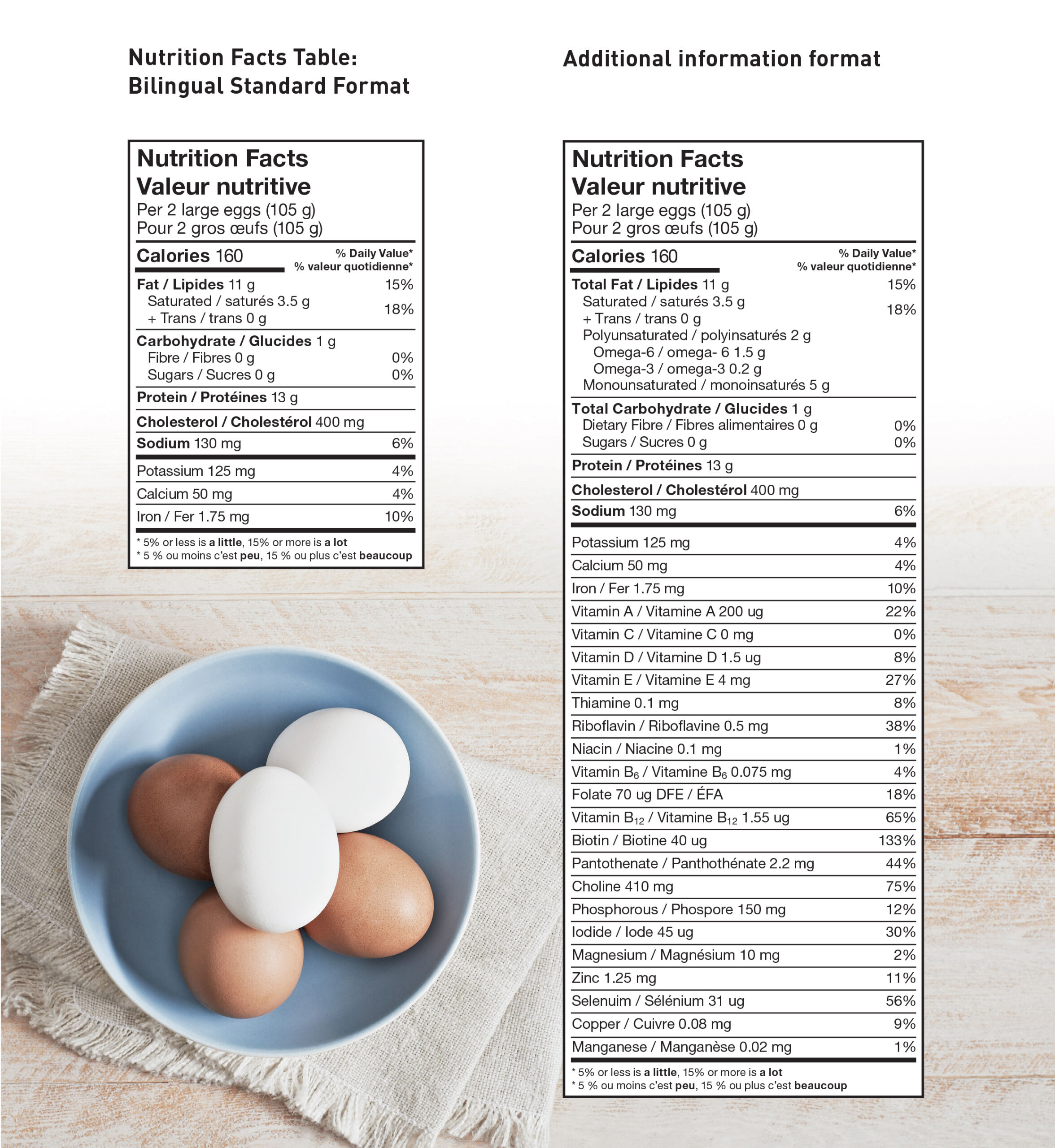
The order in which certain nutrients are displayed is going to shift. Some of the mandatory nutrients declared in the shorter version of the Nutrition Facts Table are different than in the tables you are used to seeing. For example, vitamin A and C will be removed because according to Health Canada most Canadians get enough of these nutrients in their diets.
Another change being implemented as part of the new regulations are more accurate serving sizes. In the case of eggs, the serving size has changed from one to two eggs, doubling the nutrients declared on the Nutrition Facts Table. That portion size is a better reflection of how people actually eat eggs, since Canadians will have two eggs more often than they will just have one (I guess they are too yummy to avoid seconds!).
Keep in mind you won’t see these changes immediately. There’s a five-year transition in bringing these new labels to store shelves. With a deadline of 2022, you’ll start to see new Nutrition Facts Tables slowly over time.
Yes, the Nutrition Facts Table may be changing, but one thing will never change: the simple, nutritious goodness of the humble egg.
There is a short form of an NFT which lists the mandatory nutrients. This can be found on most food products sold in Canada. There is also a longer format, which provides information on additional voluntary nutrients, which manufacturers can choose to include.
The portion size for all NFTs on large shell eggs sold in Canada is for 2 large eggs, reflecting an average serving size.
How to use the Nutrition Facts Table
The information in the NFT is based on the serving size of 2 large eggs
Use the Daily Value (% DV) to help make informed food choices. The % DV is a quick reference to tell you if a food product contains a little or a lot of a certain nutrient:
- 5% DV or less is a little
- 15% DV or more is a lot
The nutrition facts table can help you to identify nutrients you may want to limit, such as:
- sodium
- sugars
- saturated fat
The nutrition facts table can also help you to identify nutrients you may want more of, such as:
- iron
- fibre
- calcium
- potassium
As you can see, eggs contain an abundance of nutrients, and they are a great addition to your diet to help make eating healthy easier!