
How research provides real solutions to farmers
By Egg Farmers of CanadaDr. Karen Schwean-Lardner, a Professor of Poultry Science at the University of Saskatchewan, is a researcher who has dedicated her career to delivering practical solutions for farmers. In her role at the university’s College of Agriculture and Bioresources, she and her team study laying hens, as well as other poultry like turkeys and broiler chickens. We sat down with Dr. Schwean-Lardner to learn more about the important work her team is doing and how it informs egg farming today and in the future.
Solving real-world challenges
One of the most important roles of poultry science is helping farmers fine-tune their environments to support bird comfort and behaviour. Dr. Schwean-Lardner’s research into lighting systems is a prime example of how science can lead to practical improvements on farm.
“Birds perceive light very differently than we do,” she explains. “Understanding how different wavelengths influence behaviour allows us to make informed decisions about barn design.”
Birds perceive light not just through their eyes, but through their skulls. Dr. Schwean-Lardner’s research into light wavelengths is providing farmers with new tools to reduce aggressive behaviors and improve flock comfort.
“Wavelengths that come out in red colours can penetrate deeper [in hens’ skulls] and, at the other end of the spectrum, blue cannot penetrate quite as deep. When different wavelengths go through, they can stimulate different behaviours,” says Dr. Schwean-Lardner.
Recent findings from her lab suggest that blue light can reduce aggressive behaviour in pullets, offering a new tool for farmers to improve flock comfort.
Answering the industry’s call
Strong partnerships between researchers and farmers are essential to moving our agricultural sector forward. For example, research findings from projects like Dr. Schwean-Lardner’s help inform updates to Canada’s Code of Practice for the Care and Handling of Pullets and Laying Hens, which supports a strong, national approach to animal welfare standards.
“A lot of these things will end up in and have ended up in the Codes of Practice,” she says. Adding that having data helps guide decision making.
Her research is also tackling questions about nutrition and logistics. Dr. Schwean-Lardner’s lab is currently examining how nutrient supply during transport impacts the gut health of chicks.
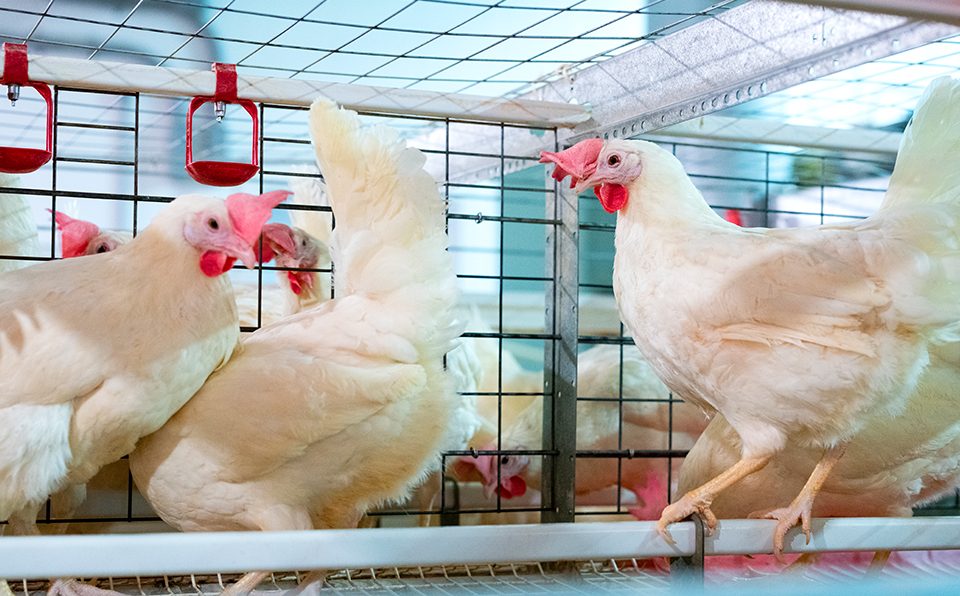
From studying light and temperature to tackling everyday on-farm challenges, collaboration between industry and researchers helps keep Canadian egg farming moving forward. Across the country, leading researchers like Dr. Schwean-Lardner are turning science into practical, real-world solutions that farmers can use every day.
What to learn more? Check out our comprehensive research program.